

The power to create value with people, and the power to discover new value and make it happen
🇰🇷 한국어로 읽기 → [Leader인가, Entrepreneur인가?]
How should we translate Leadership into Korean?
Guidance, command, leadership….
The same is true of Entrepreneurship.
These words do not refer only to personal traits or qualities, nor do they describe a single skill. They encompass a way of thinking and acting—how we see people, discover opportunities, make judgments, and take action. That is why it is difficult to capture their full meaning in a single Korean term.
So I do not want to spend too much time searching for the perfect translation.
Instead, I would rather ask these questions.
What does a Leader do?
What does an Entrepreneur do?

[Featured Image]
Harvard Business School – Arthur Rock Center for Entrepreneurship
Photo: Harvard Business School
How does Harvard explain Entrepreneurship?
Among the many definitions of Entrepreneurship, one particularly interesting definition comes from Professor Howard Stevenson, whose work has long been associated with Harvard Business School.
“The pursuit of opportunity beyond resources controlled.”
Put simply,
Pursuing opportunity without being limited by the resources you currently control.
Stevenson did not view Entrepreneurship simply as the personality or qualities of a founder. He described it as a managerial approach to seeing and pursuing opportunity.
What stands out to me here is the word Opportunity.
An Entrepreneur does not wait until everything is ready.
There may not be enough money.
There may not be enough people.
There may not even be certainty about the market.
Even so, an Entrepreneur discovers possibilities that others may not yet see and moves toward them.
Someone who asks not first, “What do I have now?”
but “What possibility is here?”
I believe this is an important starting point for understanding an Entrepreneur.

[Photo 2]
Harvard Business School – Baker Library
Photo: Harvard Business School
At the heart of Entrepreneurship is Opportunity
Scholars who study Entrepreneurship define it in somewhat different ways.
But across many studies, one word appears again and again: Opportunity.
Major research on Entrepreneurship examines who discovers opportunities for new goods and services, how those opportunities are evaluated, and how they are exploited.
In simple terms, the process looks like this.
Discover an Opportunity.
Evaluate its potential.
Connect the people and resources needed.
Take Action.
And create Value.
The important point is that having a good idea is not enough.
What matters is actually moving—Action.
No matter how good an idea may be, the world does not change if the idea remains only a thought.
Action is needed to turn possibility into reality.
Peter Drucker Saw Change
Management thinker Peter Drucker emphasized Change and Innovation when discussing Entrepreneurship.
An Entrepreneur searches for change, responds to it, and exploits it as an opportunity.
This perspective becomes even more interesting when we consider the world we live in today.
AI has arrived. Distribution is changing. The ways people obtain information, buy and sell products, and work are changing rapidly.
For some people, these changes represent a crisis.
But an Entrepreneur looks at the same change and asks one more question.
“What new opportunity might exist within this change?”
We may look at the same world, yet discover very different things.
Change → Opportunity → Innovation → New Value
Ultimately, What Matters Is Value
When we look at research and international frameworks on Entrepreneurship, another important word emerges.
Value.
The OECD, in describing Entrepreneurial Activity, also focuses on human action aimed at creating new value by identifying and exploiting new products, processes, markets, and related opportunities.
Ultimately, several important words connect.
Opportunity.
Change.
Innovation.
Action.
Value.
It is about discovering opportunity, seeing possibility in change, finding new ways forward, taking action, and ultimately creating value.
That is why I summarize Entrepreneurship in my own way as follows.
Entrepreneurship
Discovering value, developing it, and making it happen.
Discovering value,
developing it,
and ultimately making it happen.
This is not a direct quotation from any one scholar.
It is my concise expression of what I have come to understand through studying Entrepreneurship and working with people in the field over many years.
Then What Is Leadership?
Suppose we have discovered a new possibility.
We also have a good idea.
But can we accomplish it all alone?
In the end, we need people.
We need to engage with people, reconcile different ideas, share direction, enable each person to contribute their strengths, and create results together.
That is why I describe Leadership this way.
Leadership
Working with people to create value.
Working with people to create value.
Seen this way, the distinction between Leadership and Entrepreneurship becomes clearer.
An Entrepreneur discovers and creates a new path.
A Leader walks that path with people.
Leader or Entrepreneur?
So which one should we be?
I do not believe we need to choose one or the other.
Even if we are excellent at discovering new opportunities, they may remain only good ideas if we cannot execute them with people.
Conversely, even if we build strong relationships and lead organizations well, it is difficult to create new value in a changing world if we cannot discover new possibilities and act on them.
The power to discover a new path,
and the power to build that path with people.
We need both.
That is why I like the expression Leader and Entrepreneur.
It is not about moving from Leader to Entrepreneur. Nor is it about choosing between being a Leader or an Entrepreneur.
It is about Leadership and Entrepreneurship working together within the same person.
That, I believe, is what matters.
Must an Entrepreneur Be a Founder?
When we hear the word Entrepreneur, we often think of a company founder or business owner.
But I prefer to see the idea much more broadly.
In the workplace, some people identify problems in existing methods, find better ways, and actually make change happen.
In a small shop, someone may recognize changes in customers and create new products or services.
After retirement, someone may learn new skills and create a second chapter of life.
Within an organization, someone may propose a new project, persuade others, and turn it into real results.
What matters to all of them is not the Position printed on a business card.
What did you discover?
How did you develop it?
And what did you actually make happen?
Action matters more than Position.
I believe being an Entrepreneur is less about a title and more about a way of thinking and acting.
Two Forces That Matter Even More in the Age of AI
We are now experiencing a profound transformation driven by AI.
Tasks that once required large teams, significant capital, and specialized expertise can now be attempted by individuals and small organizations with the help of AI.
From searching and analyzing information to translating, designing, producing videos, and developing new ideas, AI is rapidly extending what we can do.
Does that mean AI will solve everything?
I would rather ask a different question.
“Who will discover what needs to be done?”
Which problem should we solve? Which possibility should we pursue? What value should we create, for whom—and with whom should we make it real?
Ultimately, these questions bring us back to people.
AI is an extraordinarily powerful tool.
But discovering new possibilities, setting direction, and making them real with people still remains a human responsibility.
That is why Leadership and Entrepreneurship may become even more important in the age of AI.
The more powerful technology becomes,
the more important the people who decide what to do with it become.
Two Forces Within Us
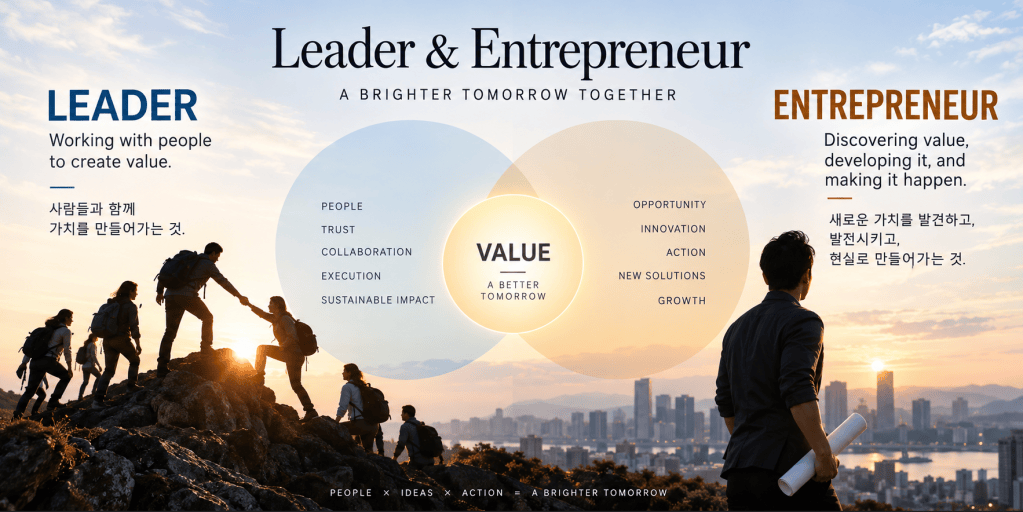
Looking back, there are moments in life when we are Leaders and other moments when we are Entrepreneurs.
And this is not limited to the workplace.
We need these two forces in our families, in small businesses, while preparing for a new career, and while redesigning our own lives.
Leadership
Working with people to create value.
The power to create value with people.
And
Entrepreneurship
Discovering value, developing it, and making it happen.
The power to discover new value, develop it, and make it happen.
Leader and Entrepreneur.
It is not about choosing one or the other.
Discovering a new path
and building that path with people.
Perhaps these are the two forces we need most as we navigate a rapidly changing world.
References
Harvard Business School / Howard Stevenson
Entrepreneurship — “The pursuit of opportunity beyond resources controlled.”
Peter F. Drucker
Innovation and Entrepreneurship — Perspectives on Change, Innovation, and Opportunity
Shane & Venkataraman
Research on the discovery, evaluation, and exploitation of Entrepreneurial Opportunity
OECD
Research and definitions concerning Entrepreneurial Activity and Value Creation

